


Total Property -
Stability sparks action
Latest Bayleys data indicates that confidence is re emerging in the industrial market as occupiers act more decisively and investors return.
New Zealand’s industrial sector is on a more balanced footing, as occupiers regain confidence and investors recalibrate off the back of stabilising yields and clearer pricing benchmarks, according to Bayleys’ Q3 2026 New Zealand Industrial Market Update.
While geopolitical friction earlier in the year created short term caution, the market has since shifted into a more forward looking phase. Occupier demand continues to stabilise supported by incentives that are lifting activity, while development feasibility holds steady. Together, these factors are shaping a competitive environment across leasing and investment markets.
Vacancy for prime industrial stock remains tight, typically ranging between one to four percent across the major centres, while more dated premises are showing marginally higher vacancy. A growing pipeline of new builds is adding choice for occupiers and reinforcing competitive tension among landlords, while investors continue to favour well located assets with strong tenant covenants, even as transaction volumes remain subdued.
Bayleys insights analyst Samantha Lee says the market has moved past the initial impact of the Middle East conflict and oil price volatility, with occupiers now planning ahead again and investors showing more interest.
“The uncertainty prompted some investors to pause and reassess market conditions, particularly around inflation, lending costs and interest rate expectations. We suspect this is likely to be temporary given it's focused on a specific event.
“We expect confidence will recover as the situation resolves, although the timelines for this remain somewhat unclear given the unpredictability of the parties involved.”
Lee notes that proactive occupiers currently hold a market advantage while stock levels remain favourable. “Those occupiers who remain on the sidelines may risk missing the opportunities the current market has to offer, whether that is greater leasing choice, reasonable lending conditions, or the ability to negotiate favourable terms.”
With yields largely stabilising, the investment market has a clearer base for assessing values, explains Lee. “Buyers continue to focus on the fundamentals of each asset, with well located properties with strong tenant covenants, quality improvements and secure lease structures attracting the strongest interest.
“Realistically priced assets are attracting competition, which shows the depth of capital for quality industrial opportunities. However, where vendor assumptions are ahead of the market, campaigns can take longer or require pricing adjustment to meet buyer expectations.”
Right-sizing rules
Bayleys national director industrial and logistics Scott Campbell says the investment market remains selective, but the fundamentals supporting industrial property remain solid. He notes that the biggest constraint on sales activity is not a lack of demand, but a shortage of owners willing to bring quality assets to market.
“We’re still starved of quality stock,” Campbell says. “Yields are holding up and demand for well located industrial assets is strong, but while sales volumes have improved from the lows of 2023, limited availability of quality stock continues to constrain activity.
“The reason assets are slow to come to market hinges on the investment flight to bricks and mortar, and right now we sense that many investors want to get through the forthcoming election cycle before deciding whether to sell.
“Buyers are backing assets that are priced to the market, and the competition we’re seeing shows just how much capital is still targeting industrial.”
Leasing momentum has returned as businesses move past the hesitation of recent years, with Bayleys’ industrial leasing team completing more transactions in the first half of 2026 than in all of 2025. Campbell says this reflects a decisive change in occupier behaviour.
“After a period of sluggish activity, occupiers have decided they cannot stand still any longer, and that sentiment shift is showing up in the numbers. Businesses are just getting on with it and securing space that genuinely supports their operations.
“Right sizing is front and centre, with occupiers being far more deliberate about the buildings they commit to and how those spaces will perform over the life of the lease.”
With solid availability across most size bands, occupiers have room to compare options and negotiate terms that support day to day operations. Eight year plus lease commitments remain common, which suggests occupiers are backing their long term plans and see stability in the market.
Campbell says development feasibility has also bounced back, supported by stable rents, yields and construction costs, with sizeable projects now planned or underway nationwide.
“It’s encouraging to see developers actively acquiring land in locations with signalled long term growth potential.”
Cubic opportunity
Michael Hutchings, director of independent project and cost management consultancy RDT Pacific, says owner-occupiers, investors and developers are entering a period of renewed confidence. Construction cost inflation has stabilised, occupiers are clearer about what they need, and regulatory changes are opening new pathways for smarter, more efficient development.
“With occupier requirements shifting, the next decade of industrial assets will be defined by height, automation and operational performance,” says Hutchings.
“RDT’s value lies in ensuring quantity surveyors price projects correctly from day one, managing delivery programmes so occupiers can plan their move with certainty, and ensuring buildings are engineered for clear height, floor loading, yard depth, truck movements, power capacity and automation readiness.”
Despite lingering economic headwinds, competitive tendering and eased lead times make this a favourable window to commit, especially with the Building (Overseas Building Products, Standards, and Certification Schemes) Amendment Act 2025 opening new pathways for internationally certified building products.
Hutchings says over time this should mean more competition, more choice and less exposure to single supplier risk.
“Build cost inflation has come back to earth, with the bigger constraint now not the building, but the land,” he says.
Prime Auckland industrial land currently sits at around $950-$1,200 per square metre and good sites are genuinely scarce meaning the smart money is building more efficiently and going up rather than out, with height where the most significant shift is occurring.
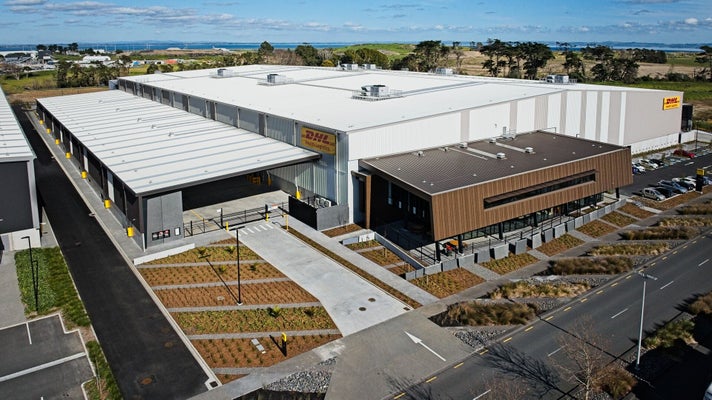
RDT Pacific managed the entire development process of DHL Health Logistics’ purpose-built facility on Te Kapua Drive, in Auckland Airport's The Landing Business Park.
“Modern fire engineering has unlocked the cube. In a market where land is the expensive part, height is the cheapest space you can buy,” explains Hutchings.
“Updated sprinkler standards and performance-based fire design now allow clear heights of 12 metres or more, and racking systems can finally use that volume. Many occupiers are sitting on untapped capacity, and we see warehouses with eight to 12 metres of stud height often racking only to four or five metres. Reconfiguring can recover 20 to 30 percent more pallet positions from the same footprint.”
Hutchings says the biggest mistakes occupiers make tend to come from treating a new facility as a property decision rather than an operational one with time, future proofing, and automation readiness the recurring blind spots.
“The cheapest time to change a building is while it is still a drawing so early engagement is where the real money is saved.
“Globally, the shed is becoming a machine. Taller, far more automated, and judged on how well it runs, not just where it sits.
“High-bay automated storage systems and multi-level warehouses are already reshaping offshore markets, and with Auckland land values where they are, New Zealand is next.”
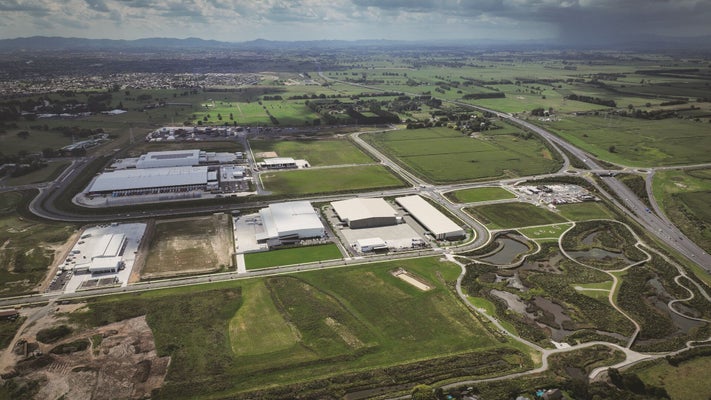
Ruakura Superhub
Ruakura Superhub – Waikato
Ruakura is becoming a central logistics hub in New Zealand’s industrial network. Placed strategically between Auckland, Hamilton and Tauranga in the country’s economic Golden Triangle, it is optimally placed in the zone that moves around half of the country’s freight and generates more than half of our national GDP. With direct rail links to both MetroPort Auckland and Port of Tauranga through twin 800 metre sidings, and immediate access to the Waikato Expressway, Ruakura gives occupiers reliable north–south transport connectivity that is difficult to replicate elsewhere in New Zealand.
Scale is one of Ruakura’s greatest strengths, with the 610-hectare inland port, logistics and industrial superhub one of the largest masterplanned industrial developments in Australasia. The precinct embeds long-term sustainability through Green Star buildings, rooftop solar, wetlands and ecological restoration.
The inland port’s expansion is projected to eliminate up to 65,000 truck movements annually when fully operational. Stage 1 of the logistics and industrial zone covers 120 hectares and is home to major operators such as Maersk, Kmart, Big Chill and Waitomo Group. Tainui Group Holdings and Brookfield Asset Management are developing seven flexible warehouse units totalling 14,560 square metres with strategic proximity to the Ruakura Inland Port offering units from 1,000 to 4,500 square metres and targeting a minimum 4 Green Star rating, with Calder Stewart targeting completion by April 2027.
Ruakura Energy provides a dedicated electricity network for large industrial users, and the nearby Tuumata Rise subdivision will support workforce housing as the precinct grows.
The masterplanned Ruakura Superhub gives occupiers integrated supply chain efficiency, multimodal transport access and scalable growth capacity. For investors, the combination of location, infrastructure and long‑term planning positions it as one of New Zealand’s strongest emerging industrial opportunities.
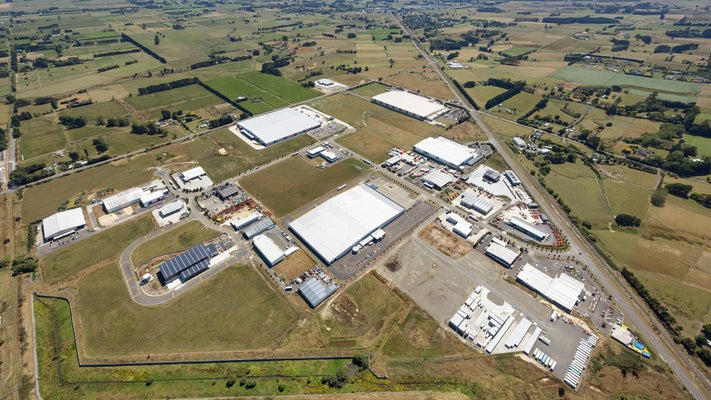
Manawatū Industrial Park
Manawatū centred on Palmerston North
Palmerston North, in the Manawatū region, is positioning itself as a key industrial/transport logistics hub for the lower North Island. Situated at the convergence of the State Highway and rail networks, it provides an ideal base for distribution throughout Wellington, Hawke’s Bay, Whanganui, Taranaki and the Waikato. Palmerston North Airport is one of only three airports in New Zealand permitted to undertake freight operations on a 24/7 basis without a curfew, and KiwiRail is also planning a regional rail/freight hub nearby.
HFH Property’s Manawatū Industrial Park is a circa 85-hectare, fully serviced precinct positioned at the crossroads of these key transport routes and adjacent to both Palmerston North Airport and the future KiwiRail regional freight hub. The area has already attracted several major early movers, with both Foodstuffs and Woolworths establishing large-scale distribution centres in the vicinity and occupiers associated to the Defence force.
The Manawatū region is attracting increasing attention due to its diversified economy, strong transport connectivity, and the availability of extensive, flat greenfield industrial land.
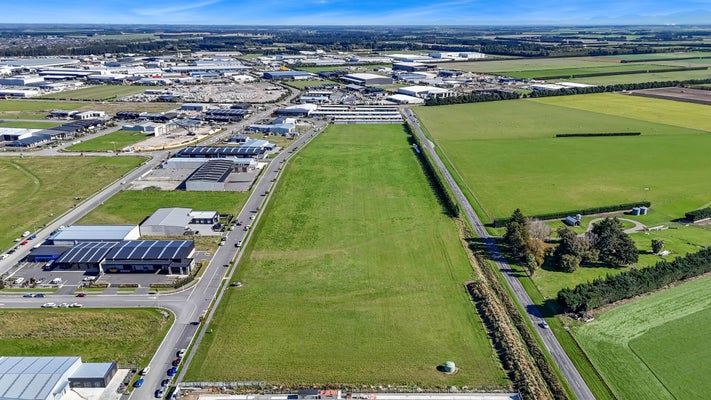
Iport Business Park
Rolleston – Selwyn District
Rolleston is the South Island’s fastest growing industrial hub. Located 20 minutes from Christchurch, it offers materially larger industrial land parcels and lower occupation costs than the metropolitan market. The Midland Line provides direct rail access to Lyttelton Port, and SH1 delivers national distribution reach.
Purpose-built precincts such as Izone and Iport anchor the market. Izone is one of the largest industrial parks in New Zealand, while Iport provides an inland port with direct rail access to Lyttelton. Large-format warehousing for FMCG, construction materials and agribusiness is expanding rapidly. Selwyn’s explosive population growth is supported by new roads, water and power infrastructure.
Rolleston offers scale, affordability and multimodal freight access, making it the South Island’s premier industrial growth node.
Contact us


